Gas Dryer vs Electric Dryer: Gas Line Considerations
A gas dryer needs a dedicated gas line, shut-off valve, and proper venting. Here is what that means for Fountain Valley homes, from cost to permits.
A gas dryer needs a dedicated gas line with a shut-off valve within reach, a properly sized flexible connector, and a 4-inch exhaust vent - an electric dryer needs none of that but demands a 240-volt circuit. If your laundry room already has a capped gas stub and a 120-volt outlet, a gas dryer is the simpler swap. If it only has a 240-volt receptacle, you are looking at running a new gas line or buying electric.
We install and repair dryer gas lines across Fountain Valley every week, and the same three questions come up: is there a line, what does it cost to add one, and is it safe to do myself. Here is how we walk homeowners through it.
The Short Answer: What a Gas Dryer Actually Needs
Gas dryer vs electric dryer gas line considerations in Fountain Valley CA come down to four physical requirements: a gas supply line sized for the dryer's BTU rating, a shut-off valve, a listed flexible connector, and combustion air plus exhaust venting. Miss any one of those and the install fails inspection or, worse, leaks.
Most residential dryers pull between 20,000 and 25,000 BTUs per hour. That is a small load compared to a furnace or tankless water heater, which is why a 1/2-inch gas line is usually sufficient for a single dryer run under 30 feet. Push past 40 or 50 feet of pipe, add elbows, or tee off to a second appliance, and you may need 3/4-inch to keep pressure steady.
Gas dryer installation Fountain Valley homeowners ask us about almost always includes the same parts list:
- A dedicated gas stub with a manual shut-off valve
- A new flexible gas connector (never reuse an old one)
- Pipe thread sealant rated for gas, not Teflon tape alone
- A rigid or semi-rigid 4-inch exhaust duct to the exterior
- A level surface and clearance for the vent per the manufacturer's manual
None of that is exotic. The trick is doing it so the connection holds pressure and passes a leak test the first time.
Gas vs Electric Dryer in Fountain Valley: The Real Differences
Gas vs electric dryer Fountain Valley comparisons usually start with operating cost, and that is fair - natural gas has historically run cheaper per load than electricity in Southern California. But the decision is really about what your house is already wired and piped for.
An electric dryer draws roughly 5,000 to 6,000 watts and needs a dedicated 240-volt, 30-amp circuit with a 10-gauge wire run. If your panel is full or the laundry room sits far from the panel, adding that circuit can cost as much as running gas pipe. A gas dryer plugs into a standard 120-volt outlet for the drum, controls, and igniter, and the heat comes from the burner.
Drying speed is close enough that most people cannot tell the difference. Gas dryers tend to reach temperature faster; electric dryers run a bit gentler on fabrics. What actually separates them in Fountain Valley is the existing infrastructure in your garage or laundry closet.
Homes built here in the 1960s and 1970s - and there are a lot of them - were commonly piped for gas dryers from the start. Newer builds and remodeled laundry rooms sometimes went all-electric. We see both, often on the same street.
If you are weighing a move to gas, start with a proper Gas Line Installation for Appliances Fountain Valley CA assessment so you know whether the existing stub is usable or needs to be replaced.
Do I Need a Gas Line for a Dryer in Fountain Valley?
Yes - a gas dryer cannot run without a gas line, and there is no adapter or workaround that changes that. You either have a gas supply at the dryer location or you do not.
Here is how to check in about five minutes. Pull the dryer out, look behind it, and find the connection point. If you see a capped pipe stub with a valve handle, you have gas. If you see only a thick 240-volt cord and a round outlet, you are set up for electric.
Two things to look at while you are back there:
- Valve condition. A shut-off valve that will not turn, or that hisses when you nudge it, is a repair - not a DIY project.
- Pipe material and age. Older homes sometimes have corroded black iron or, in rare cases, uncoated brass fittings that have given up. Rust flakes around a fitting mean the line needs attention before you connect anything.
If the stub is capped and the valve turns freely, you are in good shape. If it is corroded, seized, or missing entirely, that is when you call us.
Gas Dryer Hookup Requirements in Fountain Valley, California
Gas dryer hookup requirements in Fountain Valley, California follow the California Plumbing Code and the manufacturer's installation instructions, and the two have to agree. The code items we check on every job:
- Shut-off valve within 6 feet of the appliance and accessible without moving the dryer
- Flexible connector listed for gas appliances, no longer than 6 feet, and not routed through a wall or floor
- Sediment trap (drip leg) on the gas line ahead of the dryer valve
- Exhaust vent in rigid or semi-rigid metal, terminating outdoors - never into an attic, crawlspace, or garage
- Combustion air adequate for the appliance if it sits in a closet with a door
One detail people miss: the flexible connector must be new. Reusing the one from the old dryer is one of the most common causes of slow leaks we find. A Flexible Gas Connector Replacement Fountain Valley CA is a quick, inexpensive job that eliminates the most likely leak point on the whole hookup.
Venting matters just as much. A crushed or kinked 4-inch duct, or one that runs more than about 25 feet with multiple elbows, will trip the dryer's high-limit thermostat and leave you with damp clothes and a hot cabinet. We see this constantly in laundry closets where the dryer was pushed back against the wall.
Cost to Install a Gas Line for a Dryer in Fountain Valley CA
The cost to install a gas line for a dryer in Fountain Valley CA runs roughly $350 to $1,200 for a straightforward run from an existing gas source, and $900 to $2,500 or more when the line has to come from the meter across the house. Typical 2026 pricing in this area lands in the middle of those ranges for most single-story homes.
What moves the number:
- Distance from the meter or nearest gas appliance. Every additional 10 feet of pipe adds material and labor.
- Access. A run through an open garage or crawlspace is fast. A run through finished walls, tile, or a slab is not.
- Permits and inspection. Fountain Valley requires a permit for new gas piping, and the line has to hold a pressure test before it is signed off.
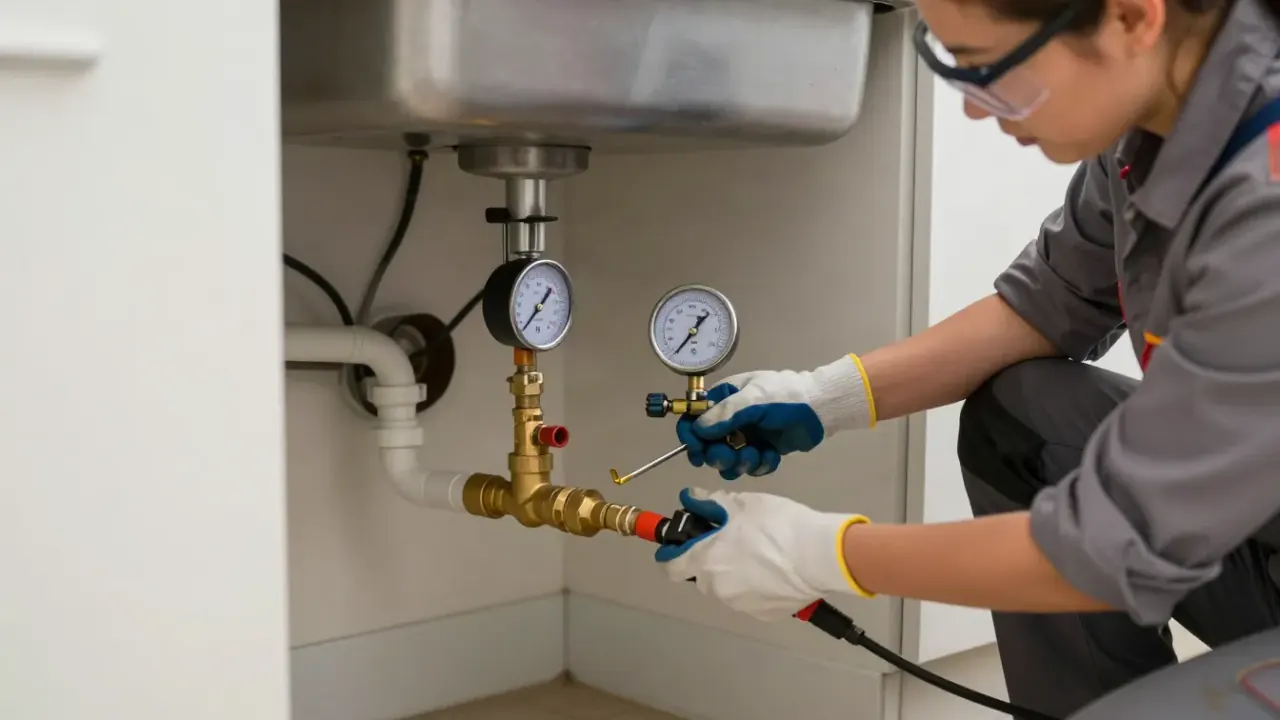
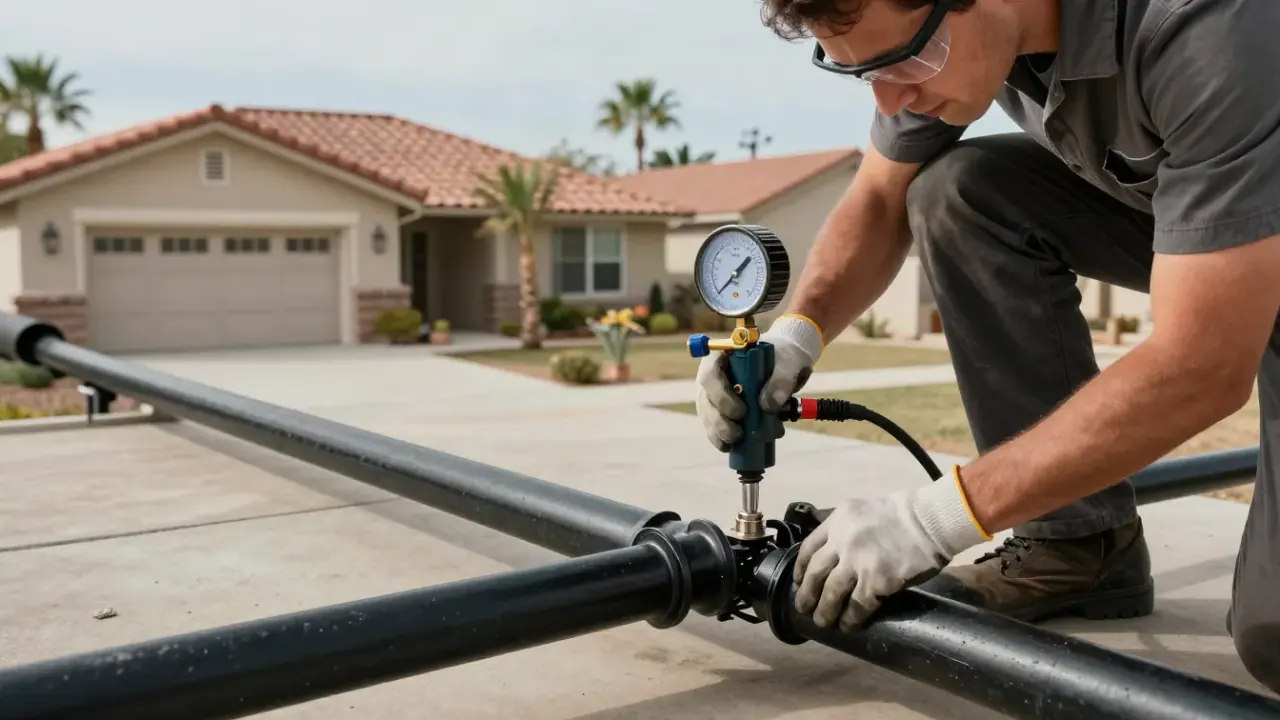
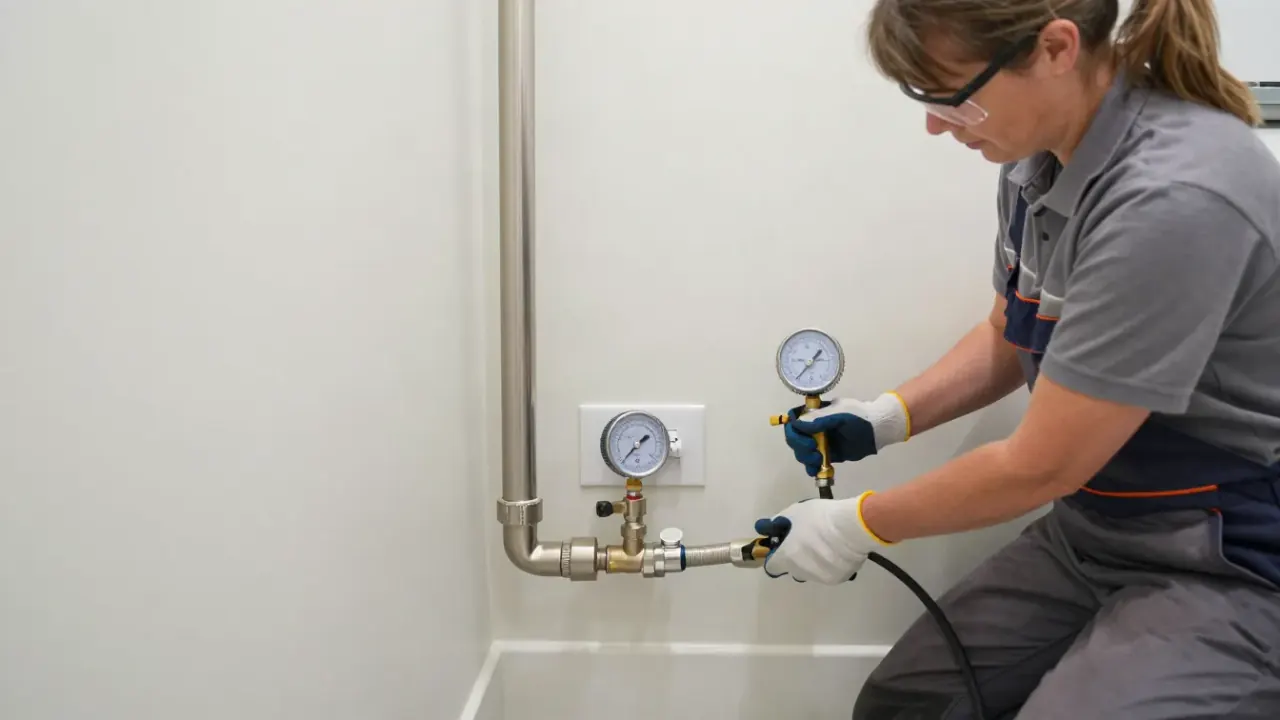
- Pressure testing. We test every new line before we leave. A Gas Line Pressure Testing Fountain Valley CA is not optional - it is how we prove the joints hold.
If you are also replacing the shut-off valve or dealing with a seized one, budget another $150 to $400 depending on access. A Gas Shut-Off Valve Repair Fountain Valley CA is far cheaper than the water damage and gas exposure a failed valve can cause.
We quote the job upfront, in one number, before we start. No surprise line items when the pipe is already cut.
Switching from Electric to Gas Dryer in Fountain Valley
Switching from electric to gas dryer Fountain Valley CA is a two-part job: run the gas line and deal with the old 240-volt circuit. You do not have to remove the circuit - capping it at the panel or leaving the breaker off is fine - but you do need to confirm the new dryer has a standard 120-volt plug for its controls.
The sequence we follow:
- Confirm the gas meter and existing piping can carry the added load. A dryer is small, but if you have also added a pool heater or generator, the total matters.
- Pull the permit and run the new line to the dryer location.
- Install the shut-off valve, sediment trap, and a new flexible connector.
- Pressure-test the line and correct the venting if needed.
- Coordinate the inspection and hand you the signed-off paperwork.
Most of these jobs are done in a single day. If the run crosses a finished ceiling or has to go through a slab, plan on two.
We handle the paperwork side too, so you are not chasing the city. Our Gas Line Permit and Inspection Coordination Fountain Valley CA covers the application, the test, and the inspection sign-off.
One neighborhood note: in older tracts like Fountain Valley Estates Gas Line Repair, we often find the original 1960s gas stub still in place behind the dryer - sometimes capped, sometimes with a valve that has not moved in 40 years. Those stubs are usually reusable after a pressure test, which saves you most of the cost of a new run.
Common Mistakes We See on Dryer Gas Hookups
The mistakes that cause problems on dryer gas hookups are almost always the same handful, and every one of them is avoidable.
- Reusing the old flexible connector. They are cheap and they are the number one leak point. Replace it every time the dryer moves.
- Using Teflon tape on gas threads. Gas-rated pipe dope is the correct sealant. Tape alone shreds and clogs.
- Over-tightening the connector. You can crack the fitting or deform the flare. Snug plus a leak test beats muscle.
- Venting into the garage or attic. This is a code violation and a carbon monoxide risk. The duct terminates outdoors, period.
- Burying the shut-off valve behind the dryer. It has to be reachable without moving the appliance.
- Skipping the leak test. A soap-and-water bubble test on every joint takes two minutes. We do it on every job.
If you smell gas at any point - a sulfur or rotten-egg odor near the dryer - stop, leave the area, and call from outside. That is not a wait-and-see situation.
When to Call a Professional
Call a licensed gas contractor when the line needs to be run, extended, relocated, or replaced - anything beyond connecting a new dryer to an existing, working stub. Gas piping is not a homeowner permit item in California, and a leak behind a wall does not announce itself until it is a real problem.
We also get called for the smaller jobs people try first and regret: a valve that will not close, a connector that will not seal, a stub that turns out to be corroded. If you are looking at rust around a fitting, that is a Corroded Gas Pipe Replacement Fountain Valley CA - the pipe has to come out, not be painted over.
And if the dryer location itself is wrong - the closet is too tight, the vent run is impossible, or you want the laundry moved to a different wall - that is a Gas Line Relocation Fountain Valley CA, which we handle as a planned job with the permit included.
Our team works across Fountain Valley and the surrounding cities. We find the problem, fix it, and test the line before we leave. If you are not sure whether your setup needs work, call and describe what you see behind the dryer - we can usually tell you in a minute or two.
Frequently Asked Questions
Do I need a gas line for a gas dryer in Fountain Valley?
Yes. A gas dryer requires a dedicated gas supply line with a shut-off valve, a new flexible connector, and outdoor exhaust venting. There is no adapter that lets a gas dryer run on electricity or an electric dryer run on gas. If your laundry area has no gas stub, one has to be installed.
How much does it cost to install a gas line for a dryer in Fountain Valley CA?
Expect $350 to $1,200 for a short run from an existing gas source, and $900 to $2,500 or more if the line has to come from the meter across the house. Permits, pressure testing, and wall access are the biggest cost variables in 2026.
What are the gas line considerations for a gas dryer in Fountain Valley?
The main ones are line size (1/2-inch is usually enough for a single dryer), a reachable shut-off valve, a sediment trap, a new listed flexible connector no longer than 6 feet, adequate combustion air, and a 4-inch metal exhaust vent terminating outdoors.
Can I convert from electric to gas dryer in Fountain Valley?
Yes, and most conversions take one day. We run the gas line, install the valve and connector, pressure-test the line, and coordinate the city inspection. The old 240-volt circuit can stay in place with the breaker off - you just need a 120-volt outlet for the new dryer's controls.
How long does a dryer gas line installation take?
A straightforward run from an existing stub takes two to four hours. A full run from the meter through an accessible garage or crawlspace usually finishes in one day. Runs through finished walls or a slab can take two days, plus the inspection window.
Get Help with Gas Line Repair in Fountain Valley
Whether you are swapping an electric dryer for gas or your existing hookup has a valve that will not budge, we can sort it out. We handle the line, the valve, the connector, the test, and the permit - one call, one crew, done right.
Call Fountain Valley Gas Line Repair at (657) 644-0068 and tell us what you see behind the dryer.